
A repeat order should be the easiest transaction in OEM procurement. The product has been supplied before, the previous order had an approved baseline, and both parties already have an order history. In theory, the buyer issues a new purchase order against the same baseline, and production resumes.
In practice, a repeat order is not automatically the same production order.
Between the previous approval and the new order, any number of inputs may have shifted: the drawing revision may have been updated, a deviation that was accepted on the previous order may no longer be valid, the tooling may have been modified, or the inspection requirements may have changed. If the buyer assumes that “same product = same production order” without reconfirming the controlled baseline, the supplier may produce against an outdated specification — and the discrepancy may not surface until inspection, or worse, until the components arrive on site.
This article walks through what a buyer should reconfirm before placing a repeat OEM order within the OEM Mining Ground Support Procurement process — and how the buyer and the supplier together establish whether a previous approved baseline can safely control a new purchase order.
Why a Repeat Order Is Not Automatically the Same Production Order
A repeat order means the buyer is purchasing the same product from the same supplier. It does not mean the controlled inputs behind that product are automatically still valid.
The previous order was approved against a specific set of controlled documents: a particular drawing revision, a particular specification, a particular sample or first-article approval, a particular set of inspection requirements, and a particular commercial baseline. Each of these inputs has its own lifecycle. A drawing may have been revised since the last order. A material substitution that was accepted as a deviation on the previous order may have been a one-time concession. The supplier's tooling may have been modified for a different customer's order.
When the buyer issues a repeat order without reconfirming these inputs, the supplier is left to make an assumption: that the previous baseline still applies. If that assumption is wrong, the cost is not just a rework or a delay — it is a loss of control over what is actually being manufactured.
The purpose of repeat-order control is not to redo the entire first-order approval process. It is to verify that the previous approved baseline still applies to the current order, identify what has changed, and release production against a confirmed, current baseline — not a presumed one.
Identify the Previous Approved Baseline
Before reconfirming anything, the buyer needs to know what was approved last time.
The previous approved baseline is the set of controlled inputs against which the last order was produced and accepted. For mining ground support components, this typically includes:
- Drawing and specification revision — the exact revision level that was approved for the previous order
- Approved deviations or concessions — any temporary acceptance, deviation, or special approval that was granted on the previous order
- Sample or first-article approval — whether a sample or first article was approved, and what the approval was based on
- Material, tooling, and manufacturing route — the material grade, coating specification, tooling setup, and manufacturing process that were used
- Inspection and documentation requirements — the inspection plan, acceptance criteria, and document package that were applied
- Marking, packing, and shipping inputs — the label artwork, packaging specification, and shipping documentation that were used
- Commercial baseline — the agreed pricing, tooling scope, and commercial terms
This baseline is not a single document. It is a collection of controlled inputs that together define what “the approved order” actually means. The buyer should reference the previous purchase order number, the approved drawing revision, and any approval records to reconstruct this baseline before reconfirming anything.
If the previous baseline cannot be clearly identified — for example, if the approved drawing revision is not recorded, or if deviations were granted verbally without documentation — the order should not be released solely on the assumption that the previous baseline still applies. The buyer may need to re-establish the applicable approval baseline before production release.
Confirm the Current Drawing and Specification Revision
The first and most critical input to reconfirm is the drawing and specification revision.
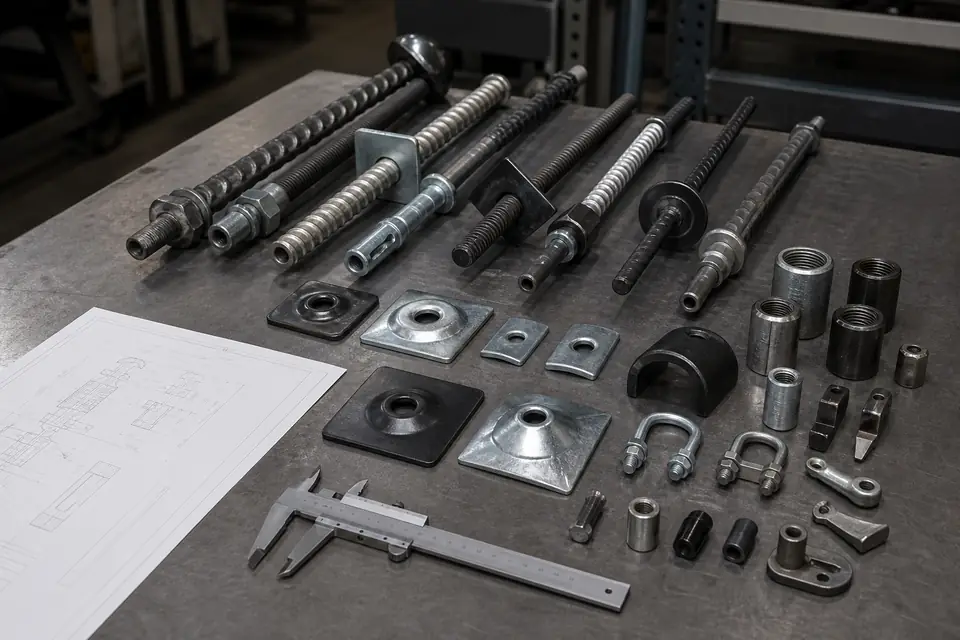
Drawings for mining ground support components — rock bolts, bearing plates, nuts, W-straps, mesh, cable anchorage components and other buyer-defined ground-support hardware — are often revised. A revision may correct a tolerance, update a material callout, modify a thread profile, or add a surface treatment requirement. If the buyer does not confirm the current revision, the supplier may produce against the previous revision — which may no longer reflect the buyer's controlled requirements.
The buyer should:
- Identify the drawing revision that was approved on the previous order. This is the baseline revision.
- Check whether the drawing has been revised since the previous order. If the revision level has changed, the current revision should be reviewed and approved through the applicable order-control process before production — even if the changes appear minor.
- Confirm that the specification referenced in the drawing is still current. Specifications (material standards, coating standards, thread standards) may have been updated or superseded.
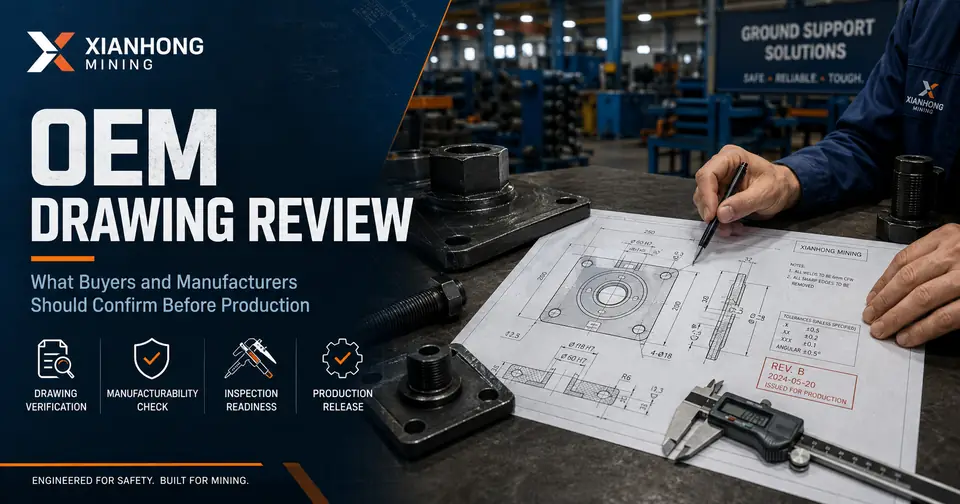
- Verify that the drawing is the controlled, approved version — not a working draft or a superseded copy. As established in the OEM Mining Ground Support Procurement process, a drawing that has been received is not the same as a drawing that has been released for production.
If the drawing revision is unchanged and the specification is still current, this input can be confirmed as still applicable. If the revision has changed, the buyer should review the current approved drawing revision through the drawing review process before releasing the repeat order.
Check Whether Approved Deviations or Concessions Still Apply
On the previous order, the buyer may have accepted one or more deviations — a tolerance that was slightly out of spec, a material substitution that was approved as an exception, or a process step that was modified with the buyer's knowledge. These deviations were approved for that specific order. They do not automatically carry forward.
The buyer should:
- List all deviations, concessions, or special approvals that were granted on the previous order. This includes any deviation approval records, any accepted nonconformances, and any special agreements documented in the previous order file.
- For each deviation, determine whether it is still applicable to the current order. A deviation or concession approved for the previous order does not automatically apply to the new order. If the buyer wants the same exception to continue, it must be explicitly re-approved and included in the current controlled order information.
- For deviations that the buyer wants to continue, formally re-approve them and include them in the current order documentation. A deviation should not continue by default — it should continue by explicit buyer confirmation.
- For deviations that are no longer applicable, confirm that the supplier will produce to the full specification on the current order.
The key principle: a deviation approved on a previous order cannot be presumed to continue on a repeat order. Each deviation must be re-confirmed by the buyer and, if applicable, re-documented in the current order file.
Decide Whether the Previous Sample or First Article Remains Applicable
If the previous order included an approved sample or first article, the buyer should determine whether that approval can serve as the reference baseline for the repeat order.
There are two scenarios:
Scenario A: The buyer confirms that the previous sample or first article remains valid.
If the drawing revision is unchanged, the specification is unchanged, and the manufacturing inputs (material, tooling, process) are unchanged, the buyer may confirm that the previous sample or first-article approval remains applicable to the current order. In this case, it may continue to serve as the reference baseline, and a new first article may not be necessary unless required by the current order-control documents or buyer approval process.
This confirmation must come from the buyer. The supplier cannot unilaterally decide that the previous sample or first article is still valid — the decision to continue using a previous approval as the reference baseline is a buyer-side control decision.
Scenario B: The buyer does not confirm, or requires a new first article.
If the buyer has not confirmed that the previous approval remains valid, or if the drawing revision has changed, or if the manufacturing inputs have changed, the previous sample or first article should not be used as the reference baseline. In this case, the buyer should confirm whether a first-article approval is required for the current order.
The key principle: the previous sample or first article can continue as a reference baseline — but only when the buyer has confirmed its validity. It does not continue by default.
Review Material, Tooling and Manufacturing-Route Changes
Even when the drawing revision is unchanged, the material, tooling, and manufacturing route may have changed since the previous order. The buyer should reconfirm these inputs.
Material: Has the material grade or specification changed? If material sourcing has changed, does that change affect any buyer-controlled material, traceability, approval, or documentation requirement? If a coating or surface treatment is specified, does the current process still meet the buyer-approved requirement?
Tooling: If the previous order used specific tooling — a particular die, mold, fixture, or thread-rolling setup — is that tooling still available and still suitable? Tooling may have been modified, retired, or allocated to a different product. The buyer should confirm that the tooling used on the previous order is still available and still applicable, subject to current order requirements.
Manufacturing route: Has the manufacturing route changed since the previous order? If it has, does the change affect any buyer-controlled specification, approved process requirement, inspection scope, or documented baseline?
The key principle: if the current order requirements have not changed, the previous tooling, material, and manufacturing route can continue to be used — subject to current order requirements. If the drawing, specification, or buyer requirements have changed, the tooling, material, and manufacturing route must be re-verified for applicability.
If a material source, external process, subcontracted operation, tooling route or manufacturing method is controlled by the buyer-approved order documents, the buyer should confirm whether any change affects the current approved baseline. Changes to supplier-internal sourcing or subcontracting that are not part of the buyer-controlled order inputs do not automatically require buyer approval — unless they affect a controlled specification or approved baseline.
This is why the “subject to current order requirements” qualifier matters. The previous manufacturing inputs are a starting point, not a permanent approval. They remain valid only as long as the current order requirements have not introduced a change that affects them.
Reconfirm Inspection and Documentation Requirements
The inspection and documentation requirements for the repeat order should be reconfirmed — not presumed to be the same as the previous order.
The buyer should:
- Confirm the inspection plan. Does the current order require the same inspection scope as the previous order? If the previous order included dimensional inspection, material testing, and coating verification, is the same scope required? If the buyer has added or removed inspection requirements since the last order, the inspection plan must be updated.
- Confirm the acceptance criteria. Are the acceptance limits the same? If the buyer has tightened or relaxed any criteria, the supplier must be notified.
- Confirm the required inspection and document package. As defined in the mining ground support quality documents framework, the document package may include inspection reports, material test certificates, coating thickness reports, dimensional reports, and traceability records. The buyer should confirm which documents are required for the current order.
- Confirm whether previous inspection records can be referenced. If the previous order's inspection records are available and the production inputs are unchanged, the buyer may reference them as a baseline — but the current order still requires its own inspection evidence.
If the inspection requirements are unchanged, this input can be confirmed as still applicable. If they have changed, the supplier must be notified before production begins.
Reconfirm Marking, Packing and Shipping Inputs
Marking, packing, and shipping requirements are often treated as administrative details — but they are controlled inputs that can change between orders.
Marking: Has the label artwork been revised? Are the marking requirements (product identification, heat number, batch number, customer logo, country of origin) the same as the previous order? As covered in product identification and marking, marking requirements are part of the controlled specification — not a detail to be left to the supplier's discretion.
Packing: Is the packing specification the same? If the previous order used a particular export packing configuration — pallet type, quantity per pallet, moisture barrier, strapping pattern — is the same configuration required? If the buyer has changed the destination, storage, transport or contractual requirements may require different buyer-approved packing or corrosion-protection requirements.
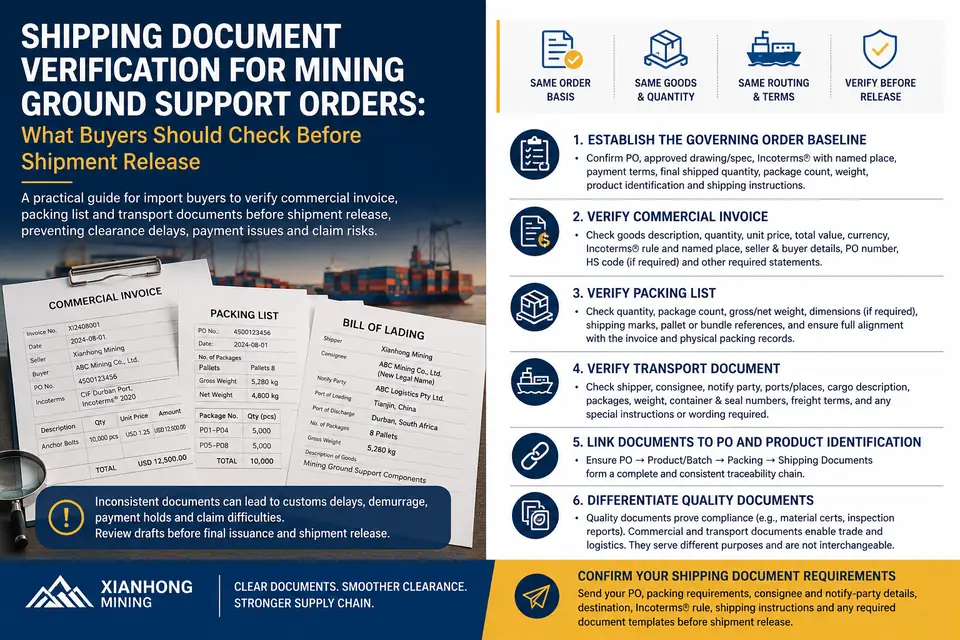
Shipping and accompanying documents: Are the shipping and accompanying document requirements the same? If the previous order required a particular set of shipping documents (commercial invoice, packing list, certificate of origin), is the same set required? Quality-related documents — such as material test certificates and inspection reports — should be confirmed separately as part of the mining ground support quality documents package, not mixed into the shipping document list.
The buyer should confirm these inputs explicitly. If they are unchanged, they can be carried forward. If they have changed, the supplier must be notified before the order is released, and the buyer should verify the shipment document package against the approved order to ensure consistency.
Build a Repeat-Order Change Matrix
Once the buyer has reconfirmed each input, the results should be organized into a repeat-order change matrix — a simple structure that captures what has changed, what has not, and what action is required.
A repeat-order change matrix typically includes:
| Input | Previous Order Baseline | Current Order Requirement | Changed? | Action Required |
|---|---|---|---|---|
| Drawing revision | Previous approved revision | Current approved revision | Yes / No | Confirm or review |
| Specification | Previous approved specification | Current buyer-approved specification | Yes / No | Confirm applicability |
| Approved deviations | Previous deviation/concession records | — | Yes / No | Re-approve or remove |
| Sample / first article | Previous approval on file | Buyer confirms validity | Yes / No | Continue as reference or require new |
| Material | Previous approved material requirement | Current buyer-approved requirement | Yes / No | Confirm applicability |
| Tooling | Previous approved tooling route | Current order requirement | Yes / No | Reconfirm suitability |
| Manufacturing route | Previous approved process | Current order requirement | Yes / No | Confirm or review |
| Inspection scope | Previous inspection plan | Current inspection plan | Yes / No | Confirm or update |
| Marking | Previous artwork / marking spec | Current buyer-approved spec | Yes / No | Confirm or update |
| Packing | Previous approved packing requirement | Current buyer-approved packing requirement | Yes / No | Confirm or update |
This matrix serves two purposes. First, it helps the buyer go through each input systematically — not just the ones that are “top of mind.” Second, it provides a documented record that the repeat order was released against a confirmed baseline, not a presumed one.
A repeat-order change matrix is one practical way to document this review. It may be maintained as a spreadsheet, a table in the purchase order file, a section in the RFQ, or another buyer-approved order-control record. What matters is that the review is completed, that it covers all controlled inputs, and that both the buyer and the supplier have reviewed the results before production is released.
Release the Repeat Order Against the Current Approved Baseline
Once the applicable inputs have been reconfirmed and the current baseline is documented, the repeat order can be considered for production release.
The release decision is straightforward:
- If no controlled inputs have changed, the order may be released against the same approved baseline as the previous order, with the repeat-order review documented in a change matrix or another buyer-approved order-control record.
- If some inputs have changed, the order is released against the updated baseline — with the changed inputs reviewed and approved through the appropriate process (drawing review, deviation approval, first-article approval, or inspection plan update) before production begins.
- If the previous baseline cannot be reconstructed, the order should not be released solely as a repeat against the previous order. The applicable approval baseline should be re-established before production release.
The release is not a single signature. It is the point at which the buyer confirms that the current approved baseline — not the previous one, not a presumed one — is the controlled set of inputs against which the supplier will produce.
This is the same principle that governs the drawing review process: reviewed does not mean released. A repeat order is released for production only when the buyer has confirmed that the current baseline is valid, complete, and applicable to the current order.
Responsibility Boundary
Repeat-order control is a shared responsibility — but the boundary between buyer and supplier is clear.
Buyer responsibilities:
- Define the controlled requirements for the current order (drawing revision, specification, inspection scope, marking, packing)
- Confirm whether previous deviations or concessions still apply
- Confirm whether the previous sample or first article remains valid as a reference baseline
- Identify what has changed since the previous order
- Approve any changes before production is released
Supplier responsibilities:
- Execute the order against the confirmed, current approved baseline
- Notify the buyer if any controlled order requirement cannot be met, or if a change in tooling, material source, manufacturing route or other input affects the buyer-approved specification or baseline
- Not presume that previous deviations, concessions, or special approvals continue without buyer confirmation
- Produce to the current order requirements — not to the previous order's requirements unless explicitly confirmed
The buyer defines the controlled requirement. The supplier reviews and executes the approved order. This boundary does not change between a first order and a repeat order — the buyer still owns the requirement definition, and the supplier still owns the execution against that requirement.
Repeat-Order RFQ / PO Checklist
The following checklist summarizes the key items a buyer should reconfirm before placing a repeat OEM order for mining ground support components:
- [ ] Drawing revision: Confirm the current approved revision matches the previous order, or review and approve the new revision
- [ ] Specification: Confirm the referenced material, coating, and thread standards are still current
- [ ] Deviations and concessions: List all deviations from the previous order; re-approve or remove each one
- [ ] Sample / first article: Confirm whether the previous approval remains valid (buyer-confirmed), or require a new first article
- [ ] Material: Confirm the material grade and specification are unchanged, or review any changes
- [ ] Tooling: Confirm the previous tooling is still available and applicable, subject to current order requirements
- [ ] Manufacturing route: Confirm the manufacturing process is unchanged, or review any changes
- [ ] Inspection scope: Confirm the inspection plan and acceptance criteria, or update as needed
- [ ] Document package: Confirm which inspection and quality documents are required
- [ ] Marking: Confirm the label artwork and marking requirements are unchanged, or provide the updated artwork
- [ ] Packing: Confirm the packing specification is unchanged, or provide the updated requirements
- [ ] Shipping: Confirm the shipping documentation requirements
- [ ] Repeat-order review record: Document the review using a change matrix or another buyer-approved order-control record, and ensure the applicable results are agreed before production release
This checklist is not a substitute for the full order control process — it is a focused tool for the repeat-order scenario, designed to ensure that the buyer has reconfirmed every controlled input before issuing the purchase order.
If you are preparing a repeat OEM order, send the current purchase order or RFQ, the current drawing/specification revision, and the previous order reference. Xianhong can review the submitted requirements for manufacturability and identify items that need clarification or order-level confirmation before quotation or production release.
Sources and evidence basis
- OEM Mining Ground Support Procurement: From RFQ and Drawing Review to Shipmentinternal