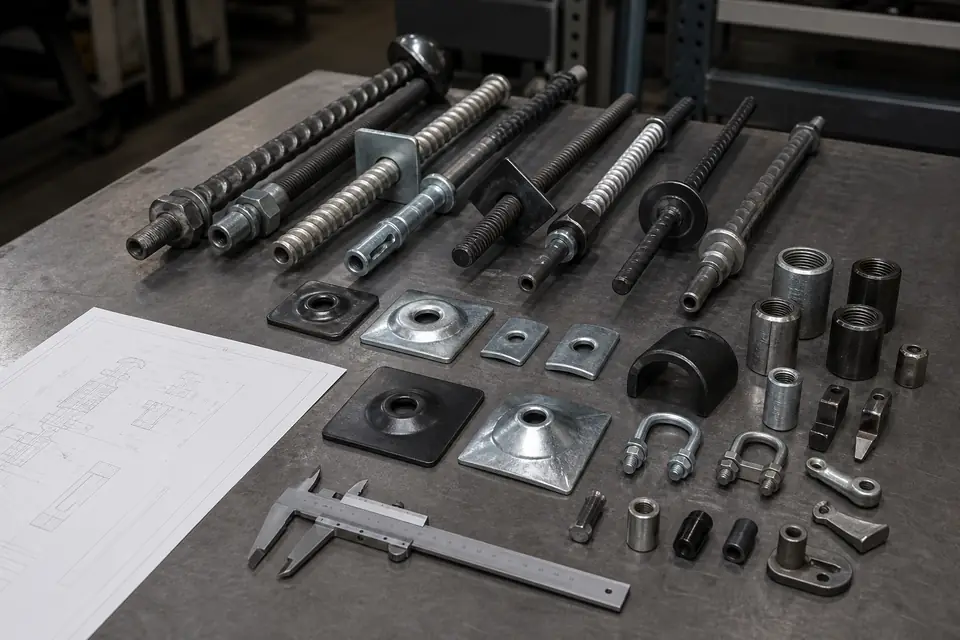
Supplier claims are a starting point, not supplier-qualification evidence. For a drawing-based mining ground-support component, a buyer needs to know which organization will make the quoted item, which approved requirements will control it, and what records can be linked to the order.
This checklist is a buyer-led method for asking those questions. It does not prescribe a universal supplier-approval threshold or replace the buyer's own qualification procedure. It sits before the order stages described in the OEM Mining Ground Support Procurement guide.
1. Define the product and decision you are evaluating
Qualification should be specific to a product, supply route and proposed order. A supplier may be able to manufacture one component in-house, use an external processor for another operation, and source a different finished component. Approval for one item does not establish the same scope for every item in a catalogue.
Before requesting evidence, identify the component and the next decision: an exploratory RFQ, a technically comparable quotation, a sample or first-article order, or release of batch production. These are different gates. An RFQ can be used to close information gaps; it does not itself approve a supplier or authorize production.
Ask which drawing, specification, sample or buyer-defined target parameters apply, including their current revisions. Where the requirement is incomplete, record the open item and decide who has authority to answer it. Product selection, component combination and support-system design remain with the buyer and qualified project authority.
2. Identify the contracting and manufacturing parties
A trading brand, contracting entity, factory, outside processor and finished-item source may be different parties. That arrangement is not automatically disqualifying. The buyer needs a clear allocation for the quoted product.
Request a product-specific statement of:
- who will issue and accept the quotation or purchase order;
- which facility will carry out each relevant manufacturing operation;
- which processes or finished items will be supplied by an external party;
- who will control the approved drawing and order requirements;
- who will perform or arrange each agreed inspection or test; and
- who will prepare the supplier-issued quality, commercial and packing documents.
For Xianhong-specific information, use the separate Supplier Capability page. This article explains how a buyer can verify a supplier; it is not evidence that every product or process shown on a website is performed in-house.
In-house manufacturing, outside processing and coordinated supply
For in-house manufacturing, confirm which operations actually take place at the identified supplier facility, using a product and process list rather than a general “factory direct” label. Ask which operations, if any, still go to outside parties.
For an outside process, such as an agreed coating, heat-treatment or laboratory step, ask who specifies the process, identifies the item or batch sent out, checks the returned result, and retains the report. The required process and acceptance criteria must come from the buyer-approved order documents.
For coordinated supply, identify the manufacturer of the finished or partly finished item, the requirements passed to that source, and who checks the delivered item against the buyer-approved order requirements. The commercial responsibility for a nonconforming item should be clear in the agreed order terms; a website statement alone does not settle it.
3. Check the controlled drawing and specification baseline
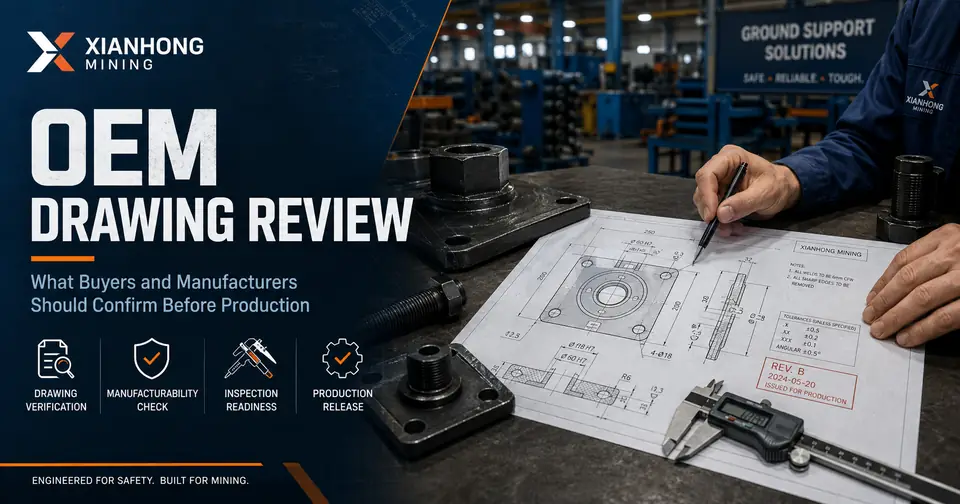
For a drawing-based component, ask the supplier to identify the documents available for the RFQ, their revisions and approval status, and any assumptions needed for a quotation. Before production release, the responsible parties must close production-critical open items and confirm the buyer-approved manufacturing baseline. Depending on the item, that baseline may include the drawing number and revision, specification edition, material grade, critical dimensions and tolerances, interfaces, surface treatment, inspection plan, marking and packing instructions.
The buyer should be able to trace a quotation assumption to the documents supplied for the RFQ, with their approval status stated, and any production instruction to the later approved and released baseline. Useful questions are:
- What prevents an obsolete revision from being used?
- How are conflicting dimensions or documents recorded and clarified?
- Which changes require buyer or qualified technical-authority approval?
- How will the approved answer be reflected in the quotation or production package?
A manufacturer may propose a manufacturable option, but a proposal is not a unilateral change to the buyer's acceptance basis. The OEM Drawing Review guide explains the document-control step in more detail.
4. Ask for an inspection plan and the records it will produce
“Strict QC” and “100% inspection” are not enough on their own. For each characteristic that matters to the order, ask the supplier to show the link between:
approved requirement → inspection or test method → instrument or laboratory → sampling or coverage → acceptance criterion → actual result → item, specimen or batch identifier → responsible party → record.
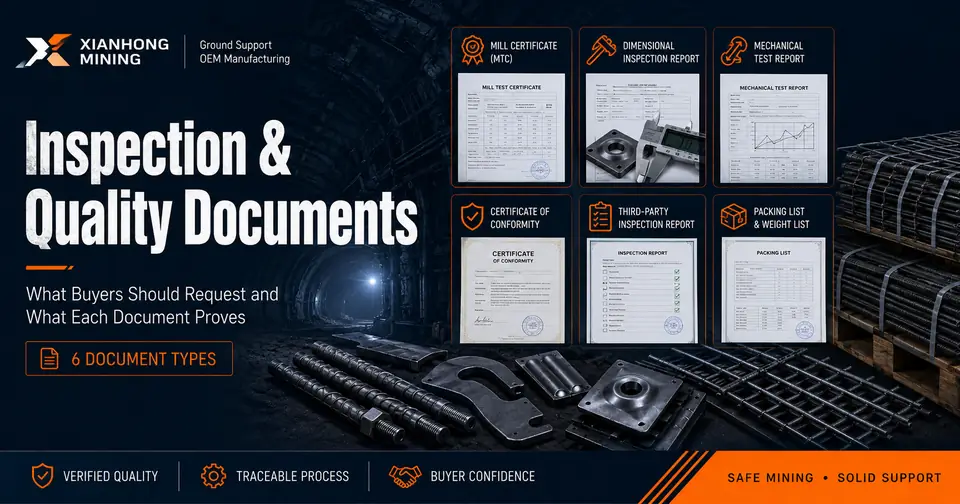
Not every characteristic needs the same method or coverage. Depending on the product and buyer-approved plan, checks might address dimensions, material identity, thread details, coating, welds or specified mechanical properties. A weight check, for example, does not by itself prove a required dimension or material property. The Quality Documents guide explains what individual records can and cannot establish.
Distinguish a factory inspection result, a material supplier's or mill's report, and an independent third-party laboratory report. If independent or accredited testing is contractually required, confirm the laboratory identity, applicable method and current scope for the specific test. Do not assume a report for one model, specimen or batch covers every item or later order.
The buyer should agree the required evidence before the relevant work begins. The eventual report should show actual results against the agreed acceptance basis, not just an unlinked “pass” statement.
5. Verify the traceability level required for this order
“Full traceability” has little meaning without a defined unit and record chain. Ask whether the order needs traceability at the material heat, external-source batch, internal production batch, inspection lot, bundle, packing unit or shipment level. The answer depends on the component and contract; not every order requires unit-by-unit identification.
Request an example of how the identifiers would connect the applicable material or source record to production, inspection, packing and shipment records. A source purchase record is not automatically a material heat record. If an outside manufacturer or processor is involved, confirm how its identifier maps to the supplier's order or batch identifier.
The purpose of this request is to verify a proposed chain, not to assume that any particular supplier already maintains every link described above.
6. Define sample, first-article and change controls when needed
A sample or first article may be an appropriate buyer-defined order gate for a new drawing, tooling change, source change or revised requirement. It is not a universal rule for every mining component, and one conforming sample does not prove that every later production unit will conform.
If the buyer requires this gate, agree in advance what will be made, which approved characteristics will be checked, what evidence will be supplied, who may approve the result, and what must happen before batch production is released. Keep inspection completion, buyer approval and production release as separate decisions. The First Article Approval guide provides a fuller buyer checklist.
When an item does not meet the governing requirement, record the nonconformance and prevent unintended release. Confirm the authorized disposition: rework and reinspection, remake, rejection, or a concession approved by the party authorized under the buyer's order-control process where allowed. A concession for one order does not automatically revise the drawing or carry over to the next order. If the approved requirement itself must change, obtain the responsible buyer or technical authority's approval and update the controlled baseline before using it.
7. Separate product marking, packing and shipment documents
Ask which requirements must be set before production release and which records can be completed later. Permanent product marks, coating-related marks, corrosion protection and packaging that affects handling or product condition may need to be defined before manufacture. Final packing counts, loading evidence and transport documents are completed at the applicable shipment stage.
The buyer can specify product or batch identification, bundle and pallet labels, shipping marks, protection method, unit or bundle weight, packing format and required photographs. Confirm which items are included in the quotation and which require a separate instruction.
Supplier-issued commercial and packing documents are not the same as carrier-issued transport documents, bank document checks, import declarations or certification decisions. Destination-country law, import eligibility, customs classification, taxes, duties and clearance requirements must be confirmed by the buyer, importer and their appointed specialists. Give the supplier the resulting marking, packing and document instructions that apply to its agreed scope.
8. Treat unclear answers as follow-up questions, not a numeric score
An unclear answer calls for clarification. It does not automatically disqualify a supplier, and the number of unchecked checklist boxes is not a defensible approval threshold.
Prioritize unresolved items by their consequence for the proposed decision. A missing material requirement, critical dimension, interface, test method or acceptance criterion can prevent a technically comparable quotation or production release. An administrative detail may be closed under the buyer's documented process without carrying the same risk. The buyer's authorized procurement and technical decision-makers should determine whether an RFQ may proceed with stated assumptions, and whether any later approval or production gate must remain closed.
Useful warning signs include an unidentified manufacturer for the quoted item, an unexplained external process, no way to name the controlling revision, inspection promises without an agreed acceptance basis, unapproved substitutions, and records that cannot be linked to the order. Ask for a specific answer or sample record appropriate to the product; do not infer that a polished general capability statement resolves the gap.
9. Buyer supplier-evaluation checklist
Use the following questions for the product and procurement stage at hand. Record the evidence reference and the person or function responsible for each open item.
| Area | Buyer verification question |
|---|---|
| Contract and supply route | Who contracts, manufactures, processes, inspects and supplies the quoted item? |
| Manufacturing scope | Which product-specific operations occur at the named facility, and which use outside parties? |
| Approved input | Which drawing, specification, sample or target-parameter revision controls the quote or production? |
| Technical clarification | How are missing or conflicting requirements resolved and approved? |
| Inspection plan | What is checked, by which method and sampling basis, against which acceptance criteria? |
| Evidence | What actual-result records will identify the item, specimen, lot or order? |
| Test source | Is a report from the factory, material supplier or independent laboratory, and does its scope fit this requirement? |
| Traceability | Which identifiers connect relevant material or source, production, inspection, packing and shipment records? |
| Sample or first article | Is one required, who approves it, and what conditions release batch production? |
| Nonconformance | Who may authorize rework, rejection or a concession, and how is the decision recorded? |
| Marking and packing | Which instructions must be fixed before production, and what shipment evidence is required? |
| Documents | Which documents are supplier-issued, and which belong to laboratories, carriers, banks or import authorities? |
The answer may be “not required for this order” if the buyer has made that decision deliberately. Do not convert a blank answer into evidence of either capability or noncompliance.
10. Move from evaluation to a controlled RFQ
Once the buyer understands the proposed supply route and remaining gaps, the next step may be a structured RFQ. The RFQ should identify the product, quantity, available drawing or specification with its revision and approval status, relevant material and interface requirements, critical dimensions and tolerances, acceptance criteria, inspection method and sampling expectations, sample or first-article gate if any, marking, packing and supplier-document requirements. State any open items and quotation assumptions rather than implying that they have already been approved. The list is not exhaustive; adapt it to the component and the buyer's procurement procedure. Production release later requires the approved manufacturing baseline and closure of production-critical open items. The OEM Manufacturing page and OEM RFQ Checklist show the next input stage.
For a drawing-based requirement, you may share the available inputs and evidence checklist that you are authorized to disclose with Xianhong Mining for a manufacturability and RFQ-input completeness review, subject to product-specific capability confirmation. Mark unapproved revisions and unresolved requirements clearly. Xianhong's manufacturing role is to review those inputs and, if an order is agreed, produce against the buyer-approved requirements released for production; the review is not an approval of product selection, component combination, ground-support design, installation or site suitability.
Start an OEM RFQ with the available drawing or specification revision, quantity, inspection and document requirements, marking and packing instructions. If an input is still open, identify it as open rather than presenting it as approved.
Sources and evidence basis
- Xianhong OEM procurement pillar governance recordinternal
- Xianhong OEM Manufacturing Processinternal
- Xianhong Supplier Capabilityinternal
- OEM Drawing Review for Mining Ground Support Componentsinternal
- Mining Ground Support Quality Documentsinternal
- First Article Approval for OEM Mining Ground Support Componentsinternal
- ISO/IEC 17025 laboratory competence overviewexternal